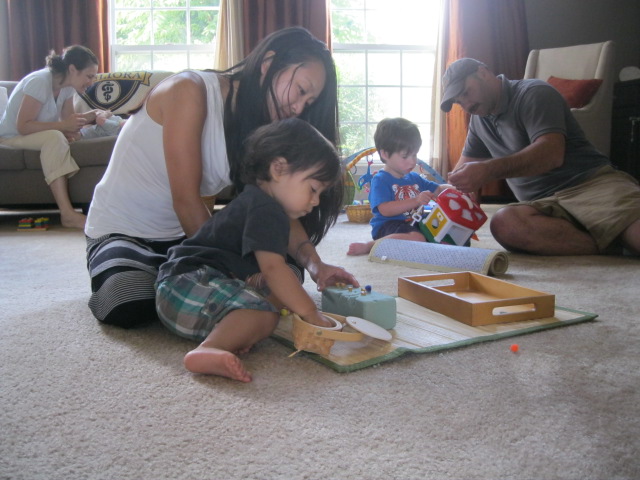
Monday, August 19, 2013

Parenting a Toddler (or "What Were We Thinking?!?")


An animated discussion with Dr. Steve, a professor of psychology (senior lecturer) at Vanderbilt University and expert in child psychology.  Despite the ponytail, Dr. Steve offers traditional advice on rearing children:  YOU are in charge!

There is a lot of bad advice out there about raising children these days.  One book I recently picked up (that looked promising at first) is very much against expecting obedience from your young children.  Another advocates explaining (until you are blue in the face?) the rules to your young children.  And still another eschews saying "No" at all!

By the time we parents of young children figure out that a lot of the advice out there is nonsense, we're exhausted, frustrated and a little suspicious of any "wisdom."  Our Montessori group recently had a treat:  a visit from "Dr. Steve," who's been working on behalf of children for 40 years, from the very poor to the privileged.  An experienced father himself and 20-year veteran of the trenches in child psychology, Dr. Steve McFadyen-Ketchum led a discussion on Parenting Toddlers 101.  He did this as a community service to pay back, as he says, "the country that made it possible for me to get an education."


Mostly he discussed the importance of Mom and Dad being "on the same page" as regards discipline. But he also offered these tips:


Dr. Steven A McFadyen-Ketchum’s Notes for Parents of Young Children


Parents need to take time out together (without children present) to discuss their children.  Child rearing in today’s situation requires partnership rather than set parenting roles. Also children change over time (develop) and their needs change. So this partnership requires frequent adult-level talk to decide what is best for each child as time goes by. 
Once a decision is made it is necessary for parents (and others who care for a child) to be reasonably consistent. It takes some checking with each to achieve this, at least two-three times per week (Dr. Steve calls this "conferring").

A child needs at all levels of development (yes this includes teens and young adults):

Enough Sleep. Generally children and adults alike are not getting enough. Chronic sleep loss is associated with childhood ADHD.
Routine. This is another place where adult-level partnering applies. No routine holds up for long in its original form in today’s world with the complex schedules many of us have (children included).
Good Nutrition. Children don’t feel well when they don’t eat a balanced diet. This is associated with behavior problems.
Clean hands. Sick children don’t feel well. This too is associated with behavior problems

Catch them being good. Children learn most readily what is required by parents when they do something that fits the requirements and it gets noticed, commented on, and reinforced (technical term that I will explain) by parents. This is not bribery. Bribes are intended to get someone to do something wrong. This is just the opposite.  (Here Dr. Steve demonstrated that using a "happy" or "gooey" voice to excitedly comment on her accomplishment can work wonders with children under 4.)

This all requires that adult needs for sleep, nutrition, stress relief, etc get met. Otherwise the child's needs can’t be reliably met. For the most part this depends upon the efforts of one’s partner (spouse).  In many cases it also depends upon the efforts of friends and extended family, all of which need to be coordinated in some way so that it is actually helpful and not inadvertently interfering.

After the discussion I asked the Montessori moms to give me their impressions.  Here's what they had to say:

Something I really found helpful was hearing "the reminders" again. She is two... and tantrums are best ignored. Don't talk to her like she's an adult and don't overly explain things when things are hairy. AND Get overly excited about the small stuff it makes them feel really good.  Great reminders for me. I found the conversation interesting from start to finish and I loved chatting with all the parents before and after the lecture. 

[We] loved it and really felt like we got some good ideas. We are going to be conferring tonight again and plan to make it a priority to schedule time to talk and talk about the kids and what we can do better and strategies we can use.  We really liked how Dr. Steve engaged the couples and asked for their real world examples and questions. One of the things that [we] are going to try and [that] stuck out to us was the "bite your lip" and just take control trick. ... I think sometimes I am trying to over explain things to [my son] and it allows him to stall when he is being non-compliant and for example saying "No, may I please not go to bath-time." I am trying to explain all the reasons why we must bathe as opposed to just taking him there.


[We] both found this evening's session very helpful. ... [My husband] said he heard loud and clear that parenting has to come from both parents and that both should discuss or check in with each other often and be on the same page. ...
His approach to 'bite the lip' is a new approach and we plan on giving it a good go. 

I did appreciate the opportunity, most importantly his reassurance that even real behavior issues can be improved with a few days of intensive effort. I also learned that I am yelling too much! 
So, all this to say that there is a hunger out there for basic, old-fashioned parenting advice.  Being positive, being firm, being united with your partner in raising your child takes a lot of work, consistency and adult-time to plan and execute.  If your playgroup or preschool has a hunger for the no-nonsense approach, then you may seek out a similarly service-oriented speaker to facilitate a discussion for you.  If couples can attend together, all the better!

Sunday, August 18, 2013

Montessori, Disabilities and the Story of Helen Keller

A novel matching work using my shell collection.  "Banjo" sits on his mother's lap and confirms that these two shells are the same.  His vision is pretty limited in one eye, so he's mostly using his sense of touch.
Can you help me find resources and information on helping this boy?

Over the summer I started tutoring 5-year-old "Banjo," using whatever I can from my Montessori bag of tricks.  Banjo cannot sit on his own, is fed through a feeding tube and has only one good eye, but he is strong and spirited!
Banjo's hands are often curled, so his mom helps him to touch....

I offered my services to sort of stimulate his senses with the Montessori materials I have at home and what I have been able to make, but honestly it's all trial and error.  I have fallen in love with not only this boy, but his entire family, so I wish I could find more out there about working with children of various abilities.  Do you know of any good websites or resources for us?


With a button he can say "yes" or "no.

I've introduced Sandpaper Letters, Fabric Matching, Sound Matching and some large-knobbed puzzles.  I'm looking forward to trying a taste matching work soon!


Along these lines I'm inspired by a movie I watched recently, The Miracle Worker.   In this review you can see that Maria Montessori had great regard for the work of Helen Keller's teacher, Anne Sullivan.  If you'd like to get your own copy, click here:  The Miracle Worker

Friday, August 16, 2013

This Moment: Following the Suggesting of Montessori Works, Just a Single Photo

To join in with Montessori Works, I'll give this a try:

{this moment} – A Friday ritual. A single photo – no words – capturing a moment from the week. A simple, special, extraordinary moment. 


Wednesday, July 24, 2013

"Follow the Child"


It's been a long summer.  Mothers all around me are looking a bit frayed (me included!).  We all seem to be looking forward to a change in pace after giving our kids more freedom for several weeks on end.  But it's been nice to see where their interests have led them during the free time....

At three-and-one-half years old, "Alleluia" has taken an interest in baking.  No surprise, given that her 16-year-old sister "Wasabi" is amazing with a wooden spoon and oven mitts, not to mention quite capable with a camera and video editing software!  This video is the result of passionate insistence on little sister's part.  You see, for weeks she has been saying something about making "gummy pops," but none of us knew what in the world she was talking about.  Finally, in exasperation, I got out the cake pop maker and said, "Ok, show me what you mean!"

She proceeded to imitate the gal on Nerdy Nummies, a Youtube channel we've consulted a few times when making birthday cakes.  I followed her around the kitchen as she narrated, crumbled up a piece of whole wheat bread, and tore up small pieces of chewing gum.

"Gummy Pops"?!?!
"You're going to want to mix it with your hands," she said casually, as if she had her own cooking show and did this everyday.

It was just too much.  Too hilarious.  And it was going to be a bit too messy (if I had let her turn the machine on and melt the gum mixture).  That's when Wasabi got out the camera and helped her make a REAL cake pop treat.  We ended up with a happy afternoon, a fun video to send to Grandma and some of "Libby's Yummies" to share.  (Oh, and this cute apron Wasabi decorated!)


Go ahead:  follow the child and see where she leads you!


Saturday, July 13, 2013

More Mobile Montessori


There is a lot of interest in my Mobile Montessori post and here are some quick answers to your questions:

--It helps if you can remove any bling bling (toys that are off limits, etc) from the area.
--I arrange works on the floor (some on mats already) in the shape of an ellipse. I intersperse blank mats, too.
 --A couple of times I actually brought light, child-sized chairs to also intersperse but half of the time the children really just ignore the chairs and sit on their moms' laps (so I stopped bringing the chairs). They take their shoes off before sitting down with the group.


--I start with the same 3 introductory songs as I always have at my house. One child was able to come to my house twice, so she kind of "got" what I was doing and she knew how to do a few of the works. I also end with the bye-bye song.
--I purposely brought several materials that are more "toy-y" that "work-y," just as schools often do for the first several weeks while they transition children slowly. That way I have time to show each child new works. By that I mean educational toys that invite manipulation, not loud electronic button toys (Melissa and Doug things or toys sold in Montessori catalogs are great).
--In a few cases I incorporated a group lesson on a work into the end of the introductory period, so everyone knew how to use it.

I didn't bring enough mats, but we still survived.....

--I haven't really done the math on how many works per child. I just take a couple of boxes worth for an hour. This time may be extended as this experiment unfolds.
--So far have done it with 3-5 children, plus the moms and any baby sibs. There are many subtle ways to instill some formality to the group, and that is important.
--A couple of times my 12-year-old daughter has helped teach the Montessori works one-on-one with any children that have bonded with her.

My daughter "Chop" helps during the Summer.

--I maintain the same strict rules about NO GERMS and if I think a younger baby sib with sniffles has been mouthing the materials I carefully wash the materials after the session and before bringing them again.
 --One last point: it's important to set up without the children touching the materials and talking with you as you do it. It may take 5-10 minutes of hard work, but then you can invite the moms and children to "school" and begin.  This is where, beforehand, you can make it clear to the parents that they are only invited to come in when they hear a chime or when you open the door.  It's helpful if one of the moms understands the need for formality and kind of protects your space while you are constructing it.

I hope this helps.  Keep the questions coming!


Wednesday, July 3, 2013

Mobile Montessori

Mobile Montessori:  All packed up and ready to go!
What can you do if you want Montessori for your children but you don't have the training or materials? One option may be to find a "Mobile Montessori" - a trained directress who is willing to come to your house, bring in her materials, and lead a class.

I never planned on doing this sort of thing (mainly because I have a bad back and assumed that I couldn't schelp the stuff), but one of the moms who came to our Montessori Mornings was very allergic to my (omnipresent) dog, so of course I was willing to try bringing a class to her house--as an experiment.  I didn't take much--just mats, some educational toys and a few traditional Montessori works.

This "Open-Close Basket" is full of empty containers  with different closures.
Well the experiment was a success, and the next time she invited some of her friends to join us.  And now another mom has started doing the same thing.   I try to bring some works that would be easy for them to put together at home, like the Open-Close Basket.  That work also has the added advantages of being light to carry,  easily replaceable if parts get lost, and attractive to a wide range of ages.

This mom of 4 helps her oldest with the Binomial Cube while her youngest inspects an empty container.
In both cases the host provides a clean, open space.  This is kind of huge--to carve out part of your house and clean it and brace yourself for the onslaught of toddlers!

This mom, the host who invited me to her home, helps with a silverware sorting work.
The Open-Close Basket is actually fun for a variety of ages.  You just need to be careful that the youngest don't put small caps in their mouths!
It takes me about 10-15 minutes to unload my materials and set them up (as if I had an ellipse on the floor), and then I begin class with group time:  songs, I Spy, and some discussion.  After a brief description of how to use the mats and an invitation to come to me for any help they may need, I let the moms and children loose on the materials.  Since new moms may not know how to use the materials, I try to give brief presentations as I see the need.

Mats help define a work area and they can help protect the floors of the hostess' house!
The class may be just an hour, depending upon my schedule and the needs of the group, but it's been a great way for those otherwise unfamiliar with Montessori or unable to attend Montessori Mornings to expose their children to it!
I've noticed that the Rosary cases with the hinged-squeezy openings are really challenging, even for older children.

/

Thursday, June 6, 2013

Practical Life/Care of the Person: Washing Hands

Get thee to a Target--these nail brushes were in the cheapo bins right at the front of the store!

A nailbrush is one of the essential tools for Montessori Hand Washing.  Cuteness is for extra credit.
If you have toddlers yourself or take care of one on a regular basis, you know that using the potty and hand washing happen ALL DAY LONG.  Make sure you have things set up so that your little one can wash his or her hands thoroughly, with very little help from you.


Last summer, when Alleluia was learning to use the potty, I wanted her to be able to wash her hands without me hoisting her up each time.  In my Montessori training we were shown how to teach hand washing at a station with a low table, a bowl, a pitcher with water, soap, etc.  I wanted to adapt the lesson to use our bathroom sink, so I made sure she had a heavy, tall step stool in front of our sink, some soap, a towel nearby and--of course--a cute nailbrush.

We fill up the sink with water (about two-thirds full) and try to make as many bubbles as possible, rubbing our soap-laden hands together under the running water.  (I think early on Alleluia convinced herself that Mr. Sink liked to eat bubbles--the more, the better.)  This is a great opportunity to have your toddler practice singing either the "A, B, C" song or the Montessori version, which replaces the letter names with letter sounds.  It's exciting when we drain the sink, because sometimes Mr. Sink makes a loud growling noise that's slightly scary!

When we remember that practical exercises such as washing hands are an important Montessori work, they don't seem like such a chore, do they?  Most children actually enjoy playing with bubbles and with water, so making more of an event out of something they must do regularly makes sense!

Here are two extra links I found in case you're interested:

http://www.youtube.com/watch?v=wDzH3Bl_jU0
http://www.infomontessori.com/practical-life/care-of-the-person-washing-hands.htm